Finding Balance in Conflict: How Dialectical Thinking Transforms Everyday Problems
Dialectical Philosophy

The Ancient Wisdom for Modern Problems
In a world of polarized opinions and heated debates, the ancient art of dialectical thinking offers a refreshing alternative to deadlocked arguments. Rooted in classical philosophy yet remarkably practical for modern challenges, dialectical philosophy provides a framework for seeing beyond either/or thinking to discover solutions that honor multiple perspectives. Unlike conventional problem-solving that often seeks to crown a "correct" viewpoint, dialectical thinking embraces the possibility that opposing ideas can both contain truth—and that the most powerful solutions emerge from their integration.
The Three-Step Process of Dialectical Thinking
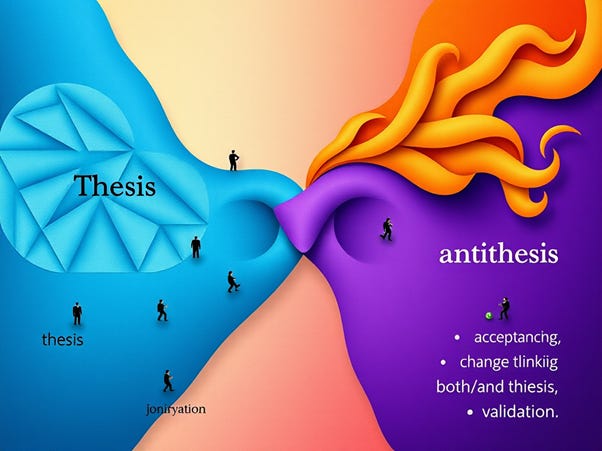
The essence of dialectics follows a three-step process: thesis (an initial position), antithesis (its counter-position), and synthesis (the integration of both). This approach originated with ancient Greek philosophers, particularly Socrates, who used questioning to reveal contradictions in rigid thinking. German philosopher G.W.F. Hegel later formalized dialectics as a method for understanding how ideas evolve through the tension of opposites. "The dialectical principle," Hegel wrote, "constitutes the life and soul of scientific progress, the dynamic which alone gives immanent connection and necessity to the body of science."
From Philosophy to Psychology: The DBT Revolution
While early dialectical philosophy focused on abstract concepts, its modern applications have profound implications for psychological wellbeing and interpersonal dynamics. Psychologist Marsha Linehan revolutionized treatment for emotional disorders by developing Dialectical Behavior Therapy (DBT), which applies dialectical principles to emotional regulation. "The dialectical approach emphasizes the essential unity or interrelatedness of reality," Linehan explains in her foundational work. "A dialectical perspective assumes that everything is connected to everything else."
Embracing Partial Truths in Conflict
At the heart of dialectical thinking is the recognition that many conflicts arise from clinging to partial truths. Consider a common workplace disagreement: one team member prioritizes careful planning while another values spontaneous innovation. The dialectical approach doesn't force a choice between these values but instead asks: How might we create a process that incorporates both thoroughness and creativity? This shift from "either/or" to "both/and" thinking opens possibilities that remain invisible when we're locked in opposition.
Finding Middle Paths Through Emotional Extremes
The power of dialectics becomes particularly evident in emotional conflicts. When feeling overwhelmed, we often swing between extremes—"I must solve this immediately" versus "This is hopeless." Dialectical thinking offers a middle path: "This situation is challenging AND I can take small steps toward improvement." This balanced perspective allows us to acknowledge difficulties without being paralyzed by them, creating space for thoughtful action rather than impulsive reactions or resignation.
The Research-Backed Benefits in Negotiation
Research in conflict resolution demonstrates that parties who can acknowledge the validity in opposing viewpoints reach more sustainable agreements. As mediator Daniel Shapiro of the Harvard Negotiation Project notes, "The most effective negotiators find ways to integrate competing interests rather than forcing compromises that leave both sides dissatisfied." This integration—the synthesis in dialectical terms—often produces solutions that would have been unimaginable from either original position alone.
Transforming Everyday Communication
The application of dialectical thinking extends beyond formal conflicts to everyday communication. Consider how often relationships deteriorate when partners become entrenched in their perspectives: "You never help around the house" versus "You're always criticizing me." Dialectical communication might reframe this as: "I feel overwhelmed by household responsibilities AND I recognize you contribute in ways I might not always notice. How can we create a system that works better for both of us?" This approach validates both experiences while moving toward constructive problem-solving.
The Paradox of Acceptance and Change
Perhaps the most profound dialectical balance in human experience is between acceptance and change. We often feel we must choose: either accept situations as they are or fight to change them. Dialectical wisdom suggests we can do both simultaneously. "The path to change begins with radical acceptance of what is," observes psychologist Marsha Linehan. This paradoxical truth forms the foundation of DBT, which teaches patients to fully accept their emotions while simultaneously working to change harmful behaviors.
Practical Steps to Develop Dialectical Thinking
Learning to think dialectically requires practice but yields remarkable benefits. Start by noticing when you're trapped in black-and-white thinking. Are you using words like "always," "never," or "impossible"? These often signal an opportunity to introduce dialectical balance. Try reframing rigid thoughts as "both/and" statements: "This project has significant challenges AND contains opportunities for innovation." Even this small shift can reduce anxiety and open creative possibilities.
Beyond Winning: A New Approach to Disagreement
When facing interpersonal conflicts, dialectical thinking offers a powerful alternative to winning arguments. Instead of focusing exclusively on proving your point, try genuinely inquiring about the other person's perspective. What concerns underlie their position? What values are they protecting? This curiosity often reveals common ground hidden beneath surface disagreements. As author F. Scott Fitzgerald noted, "The test of a first-rate intelligence is the ability to hold two opposed ideas in mind at the same time and still retain the ability to function."
The Ongoing Spiral of Understanding
Dialectical philosophy also teaches us to embrace the ongoing nature of resolution. True synthesis doesn't eliminate all tension; rather, it transforms conflict into a productive force that drives continuous improvement. Each synthesis becomes a new thesis that eventually generates its own antithesis, creating an evolving spiral of understanding rather than a static endpoint. This perspective helps us approach problems with patience and curiosity rather than demanding perfect, permanent solutions.
Applying Dialectics to Societal Challenges
The benefits of dialectical thinking extend beyond individual conflicts to societal challenges. In an era of political polarization, dialectical approaches create space for nuanced positions that transcend partisan divides. Environmental policy, for instance, might synthesize economic development AND ecological preservation rather than treating them as mutually exclusive goals. The most innovative solutions often emerge when we refuse to accept false dichotomies.
Flexibility Without Compromise
Learning to think dialectically doesn't mean abandoning your values or accepting harmful behaviors. Rather, it means approaching complex situations with flexibility, recognizing that rigid adherence to any single perspective limits our perception and potential. By embracing seemingly contradictory truths, we develop what psychologists call "cognitive flexibility"—the ability to adapt our thinking to changing circumstances rather than forcing reality into predetermined categories.
The Path to Wisdom
As we practice dialectical thinking, we discover that many apparent contradictions contain hidden harmonies. The middle path isn't about compromise in the sense of settling for less; it's about integration that produces something greater than either original position could offer alone. In our fast-paced world of complex challenges, this ancient philosophical approach provides not just a method for resolving conflicts, but a pathway to wisdom itself—the capacity to see beyond either/or thinking to the rich possibilities that emerge when we embrace life's inherent complexity.
Reader Note: This article explores philosophical concepts intended to inspire reflection and personal growth. While these timeless ideas have guided countless individuals throughout history, they are offered as perspectives to consider alongside your own wisdom and circumstances. For those facing significant mental health challenges, these philosophical practices work best when complementing professional support. Each person's journey is unique, and adapting these principles to your specific situation may yield the most meaningful results.